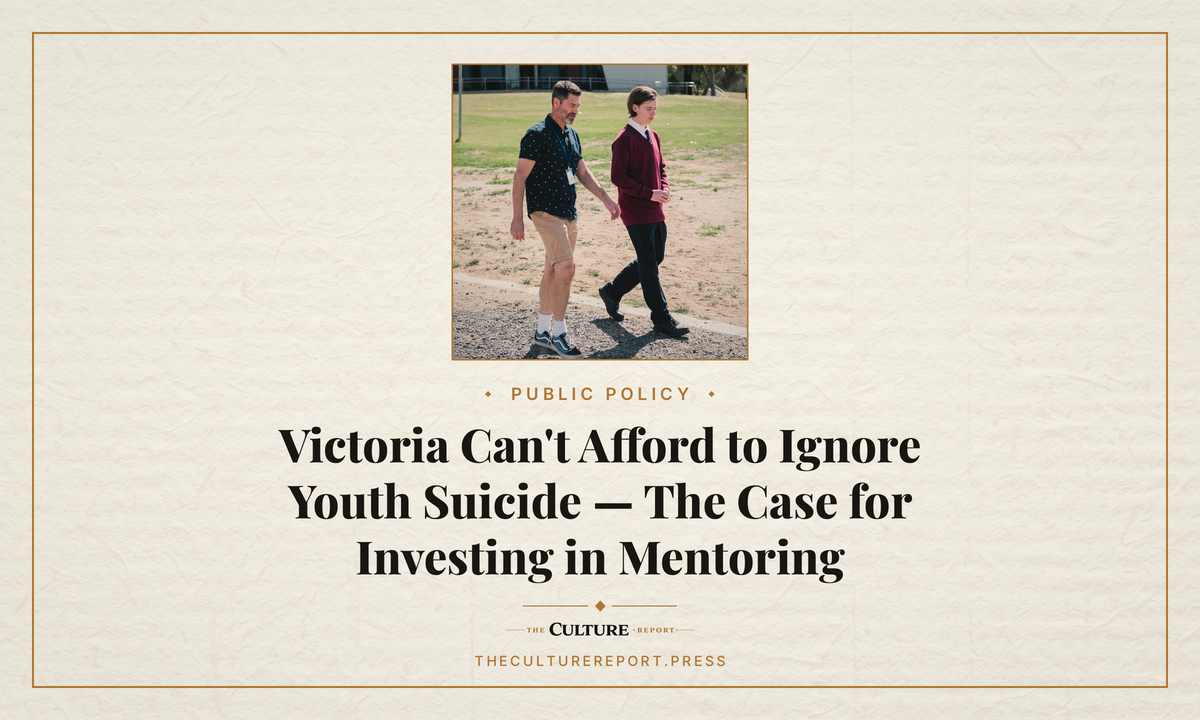
Victoria Can't Afford to Ignore Youth Suicide—The Case for Investing in Mentoring
Suicide remains the leading cause of death for young Australians aged 15-24 Beyond the human toll lies an economic cost few discuss-and a case for treating mentor as fical policy.
Every youth suicide is a tragedy that leaves families, schools and entire communities forever changed. Yet beyond the immeasurable human grief lies another reality that is rarely discussed: youth suicide carries a significant economic cost that affects every Australian taxpayer.
If governments are serious about improving youth mental health, reducing social disadvantage and investing wisely, they should view mentoring not simply as a social program, but as an economic investment.
"The true measure of a society isn't how much it spends responding to tragedy—it's how much it's prepared to invest in preventing it. Every young person deserves one trusted adult who believes in them. Sometimes that one relationship is the difference between merely surviving and truly thriving." — Mark Watt AM, CEO, Big Brothers Big Sisters Australia
The Cost of Losing a Young Life
Suicide remains the leading cause of death for Australians aged 15–24, according to the Australian Institute of Health and Welfare (AIHW). Behind every statistic is a young person whose future contribution to their family, community and the economy has been lost.
Health economists Kinchin and Doran estimated that each youth suicide costs Australia approximately $2.88 million (2014 dollars). When adjusted to today's values, that equates to around $3.5 million per young person.
These costs include:
- Emergency and coronial services
- Funeral and direct response costs
- Lost lifetime productivity
- The economic impact of bereavement on families and communities
What these figures cannot capture is the lifelong emotional trauma experienced by parents, siblings, classmates, teachers and friends.
Victoria's Growing Challenge
Victoria has experienced an alarming increase in youth suicides.
Media reporting indicates that 26 Victorians under the age of 18 died by suicide during 2023, representing a significant increase on previous years. Preliminary reporting suggests the crisis has continued into 2024.
Using conservative economic modelling, this represents an annual economic burden of approximately $70–90 million for Victoria alone.
That figure should concern every Treasurer, Health Minister and Premier—not because the value of a young life can ever be measured in dollars, but because it demonstrates the enormous cost of failing to intervene early.
We Know What Builds Protective Factors
The encouraging news is that suicide is not inevitable.
Research consistently shows that young people are less likely to experience severe mental health crises when they have strong protective factors, including:
- A trusted adult outside their immediate family
- Positive school engagement
- Healthy peer relationships
- Community connection
- Increased resilience and self-esteem
- Hope for the future
These are precisely the outcomes that quality mentoring programs seek to strengthen.
A mentor cannot solve every problem in a young person's life.
But one caring, consistent adult can change the trajectory of that life.
Why Mentoring Matters
For more than a century, Big Brothers Big Sisters has demonstrated that professionally supported mentoring creates meaningful improvements in young people's wellbeing.
Young people involved in structured mentoring programs consistently demonstrate improvements across areas associated with suicide prevention, including:
- Improved confidence and resilience
- Better school engagement
- Reduced isolation
- Stronger emotional wellbeing
- Lower engagement in risky behaviours
- Increased optimism about the future
Mentoring does not replace psychologists, psychiatrists or crisis services.
Instead, it complements them by building the protective relationships that help prevent young people from reaching crisis in the first place.
The Economic Argument
Big Brothers Big Sisters invests approximately $10,000 per year to safely support one mentoring relationship.
At first glance, that may appear significant.
However, compare that investment with the estimated $3.5 million economic cost of a single youth suicide.
If mentoring prevented only a handful of suicides each year, the economic savings would exceed the cost of expanding mentoring programs.
Conservative modelling suggests that if structured mentoring contributed to reducing youth suicides in Victoria by just 20 per cent, the State could realise economic savings of approximately $17.5 million each year.
Those savings do not include broader benefits associated with mentoring, such as:
- Lower youth crime
- Improved school completion
- Reduced substance misuse
- Better employment outcomes
- Reduced demand on health and justice systems
Viewed through this broader lens, mentoring becomes not simply compassionate policy, but fiscally responsible policy.
Prevention Delivers Better Returns Than Crisis Response
Australia spends billions responding to crises after they occur.
We fund emergency departments.
We fund ambulance services.
We fund courts.
We fund youth detention.
We fund mental health admissions.
All of these services are essential.
But comparatively little is invested in strengthening the relationships that help stop vulnerable young people reaching crisis in the first place.
Public policy too often rewards reaction instead of prevention.
That approach is neither sustainable nor economical.
A Better Investment for Victoria
Governments rightly expect evidence before investing public money.
The evidence supporting mentoring continues to grow.
International research has linked structured mentoring with improved educational outcomes, reduced offending, increased resilience and stronger social connectedness—all recognised protective factors against suicide.
No responsible organisation would suggest mentoring alone can prevent every youth suicide.
Mental illness is complex.
Trauma is complex.
Suicide is complex.
But mentoring represents one practical, evidence-informed intervention capable of strengthening the protective relationships that every young person deserves.
The Challenge Ahead
The question facing Victoria is not whether youth suicide costs the community.
It clearly does.
The real question is whether we are prepared to invest earlier, smarter and more deliberately in programs that help young people remain connected, hopeful and supported.
Every young Australian deserves someone who believes in them.
Sometimes, that one relationship changes everything.
And if it saves even one life, the return is measured not only in economic terms—but in futures restored, families kept whole and communities made stronger.
References
Australian Institute of Health and Welfare. Suicide and Self-Harm Monitoring – Young People. https://www.aihw.gov.au/suicide-self-harm-monitoring/data/populations-age-groups/suicide-among-young-people
Kinchin, I., & Doran, C. (2018). The Cost of Youth Suicide in Australia. International Journal of Environmental Research and Public Health, 15(4), 672. https://doi.org/10.3390/ijerph15040672
Productivity Commission. (2020). Mental Health Inquiry Report. Commonwealth of Australia.