Faith, Family, Business and a Life of Purpose
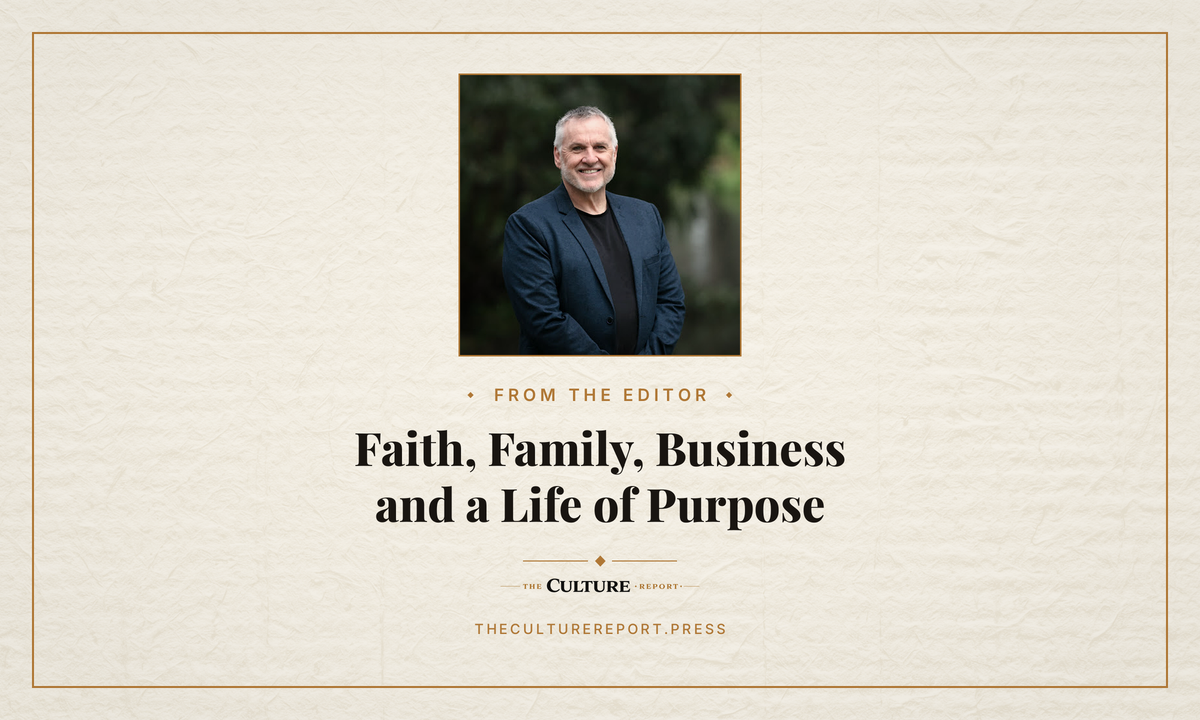
Darryn Keneally is the founder of The Culture Report. Here, in his own words, is where he has come from and what he is trying to build.
Hello, I'm Darryn Keneally.
Over the years I've worked across business, media, community services, faith-based ministry and charitable organisations. Set out as a list, those things can look scattered. They have never felt that way from the inside, because one conviction runs through all of them: that our lives, our businesses and whatever influence we accumulate are meant to be spent making a real difference to other people.
That belief is the reason this publication exists, and it is the best introduction I can give to the rest of what follows.
Faith and family
I am a follower of Jesus. That is not one detail among many; it is the centre from which I read everything else — leadership, business, family, service.
I also believe faith is meant to be practical. It is not something to be observed on Sundays and set aside on Mondays. It shows up, or fails to, in compassion, in integrity, in generosity, and in whether you are willing to stand beside someone when their situation becomes difficult and inconvenient.
Family matters to me just as much. I have seven children and five grandchildren. Being a father, an adoptive son and a community leader has given me a particular appreciation for what strong families and steady role models actually do for people — and a clear view of what their absence costs. I have known both the joy and the complexity of family life. Rather than dulling my convictions, that experience sharpened them, particularly around fatherhood, healing and reconciliation.
I am drawing on all of it in my writing, including my book Don't Cancel Fathers, which is the most personal thing I have written. It deals with fatherhood, adoption, trauma, faith and redemption, and with the case for allowing fathers the room to grow, to heal, and to stay meaningfully connected to their children.
A passion for helping people
Much of my working life has been spent alongside people facing disadvantage, hardship, addiction, disability or social isolation.
Through organisations including Allcare Community Support, Melbourne Youth Bus, In 2 Life Community Services and Big Brothers Big Sisters Australia, I have watched the right support, offered at the right moment, change the direction of a person's life. It is not a sentimental observation. It is simply what I have seen happen, repeatedly.
What interests me most are the efforts that offer people more than short-term relief. Immediate help matters, and there are moments when nothing else will do. But lasting change tends to require the slower things: relationships, mentoring, stable housing, work, spiritual support, and the ordinary experience of belonging somewhere.
That is why I am drawn to organisations that walk alongside people rather than simply process them — the ones concerned less with delivering a service than with helping someone recover their dignity, recognise their own strengths, and see a future worth moving toward.
I also believe deeply in what churches can do. Churches are usually already embedded in the places they serve, close enough to notice a need before it becomes a crisis, and well positioned to respond to it. I have been privileged to help with church planting and community development in regional, remote and Indigenous communities, including projects across South Australia, Western Australia and the Northern Territory.
My hope for the church is straightforward: that it becomes a place where faith is proclaimed and compassion is demonstrated, and where a person can encounter genuine hope and practical help in the same room.
Charity with strategy
Good intentions are the beginning of charitable work. They are not the whole of it. Effective charity also demands sound governance, disciplined financial management and a clear strategy — the unglamorous machinery that determines whether compassion actually reaches anyone.
One of my great enthusiasms is helping charities and not-for-profits become stronger, more sustainable and more effective: governance, fundraising, organisational structure, public relations, partnerships and long-term planning.
I particularly enjoy the work of moving an organisation from a worthy idea to a working model. Sometimes that means building a fundraising campaign or strengthening a board. Sometimes it means establishing a partnership, creating a new charitable entity, or finding an entrepreneurial way to fund a community program that grants alone will never sustain.
"I believe charities should be compassionate in purpose and professional in operation."
Responsible governance is not bureaucratic caution. It protects the people being served, earns the confidence of donors, and is the reason an organisation is still standing — and still useful — in ten years' time.
Business and entrepreneurship
Alongside the charitable work, I have kept an active hand in business, investment and entrepreneurship.
Those ventures have spanned community services, property development, media, renewable energy grants, international trade, technology and agricultural commodities. The projects have ranged from housing developments and software platforms to coconut-oil production in Vanuatu — a spread that has taught me more about people than about any single industry.
What I enjoy is the same in every case: spotting an opportunity, assembling the right people around it, and helping an idea travel from concept to something real. For me, entrepreneurship has never been principally about profit. At its best, business creates employment, solves problems, supports families, and generates the resources that can then be put back into the community.
I am especially interested in ventures that hold commercial sustainability and social benefit together. The two are routinely discussed as though they were in tension. My experience is that commercial discipline and social responsibility not only can work together — they work considerably better when they do.
Business has also been my education in resilience. Every venture brings difficulty, and not every idea unfolds the way it was drawn up. Leadership means navigating uncertainty, learning from what fails, making the hard call when it is yours to make, and continuing forward without quietly trading away your values along the way.
Media, communication and public life
Communication has been the other constant thread.
I have worked in media, public relations, creative writing, radio and strategic communications, much of it within the Christian and charitable sectors. It has left me with a lasting respect for what a well-told story can do — shift a perception, prompt real generosity, and give a hearing to people who would otherwise go unheard.
I care about helping leaders and organisations communicate with honesty, courage and clarity. In a media environment this fragmented, trust has become the scarcest commodity there is. Whether the channel is traditional media, radio, a social platform, a book or a room full of people, credibility has to sit at the centre of it. Everything else is decoration.
I am also genuinely interested in where journalism and public relations go from here, and in how people working in these industries build something worth leaving behind while the ground shifts under them.
Leadership through service
I have been deeply honoured to receive recognition for community service, including the Medal of the Order of Australia. Recognition of that kind is humbling, and I have come to read it less as a verdict on what has been done than as an encouragement to keep going.
Leadership is not a title. It is the willingness to accept responsibility, to remain present when a situation turns difficult, and to spend whatever influence you have on someone other than yourself.
The moments I value most have not taken place in boardrooms or at public events. They have happened in conversations with people in real trouble, in meetings where an organisation finally found its way through, and in watching an individual or a family take hold of hope again.
Looking ahead
Looking forward, I remain committed to holding faith, business, communication and charitable action together rather than treating them as separate careers.
I want to keep supporting organisations that care for vulnerable people, keep encouraging churches to engage seriously with their communities, keep building responsible business ventures, and keep telling stories that strengthen rather than divide.
My own path has held success and disappointment, opportunity and adversity, real joy and real personal difficulty. What all of it has taught me is that purpose is rarely found in the pursuit of success for its own sake. It is found in using your experience, your relationships and your resources in the service of something larger than yourself.
"Purpose is rarely found in the pursuit of success for its own sake."
That is the life I intend to keep building: grounded in faith, devoted to family, active in business, and committed to leaving people and communities stronger than I found them.