The Power of an Advisory Board: Why Every Business Needs a Table That Won't Wobble
Your business is a table. Legal, financial, people and marketing are the legs. If one is weak it wobbles — and if one disappears, eventually something hits the floor.
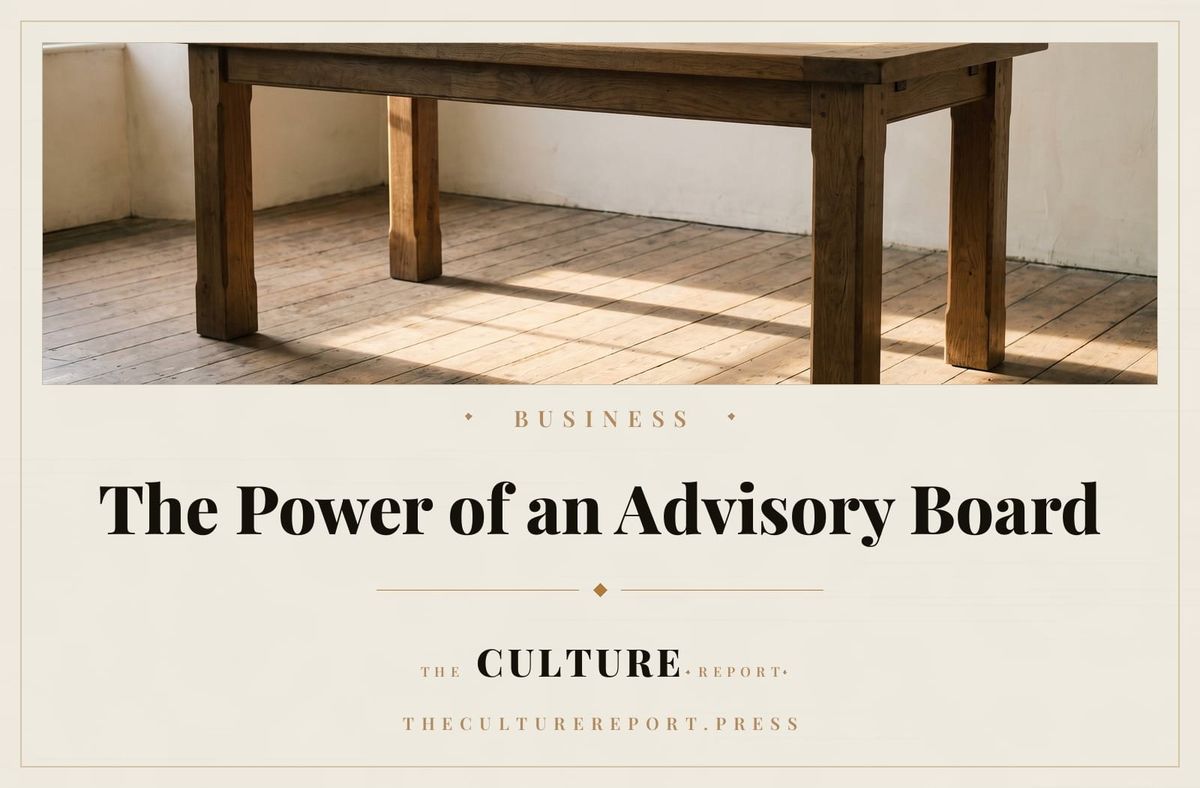
Your business is a table. Legal, financial, people and marketing are the legs. If one is weak it wobbles — and if one disappears, eventually something hits the floor.
There is a simple picture that every business owner should keep in mind.
Your business is like a table.
It doesn't matter whether you are running a start-up, a family business, a professional practice, a not-for-profit or a company turning over hundreds of millions of dollars. For the table to remain stable, it needs strong legs.
One useful way of thinking about those legs is:
- Legal
- Financial and Accounting
- People and Human Resources
- Marketing and Advertising
If one leg is weak, the table starts to wobble. If two legs are weak, the business can become seriously unstable. And if one of the legs disappears altogether, eventually something is likely to hit the floor.
This is one of the reasons I believe so strongly in the power of an Advisory Board.
What is an Advisory Board?
An Advisory Board is very different from a company's formal Board of Directors.
A director has formal governance responsibilities. In Australia, directors operate within a legal framework that includes duties under the Corporations Act and general law.
An Advisory Board is different.
Its members are non-executive advisers. They aren't there to run the company. They don't manage the staff. They don't normally vote on company decisions, and their recommendations aren't binding.
Their job is to advise, challenge, question, connect and contribute experience.
The Australian Institute of Company Directors describes advisory boards as providing objective advice, insights and recommendations without having authority to act on behalf of the organisation. (AICD)
That distinction is incredibly important.
The business owner remains in control.
The Advisory Board doesn't replace the owner, CEO, management team or statutory board. Instead, it gives those decision-makers another layer of wisdom around the table. Australian guidance similarly notes that advisory boards can provide strategic guidance without the formal decision-making authority of directors. (AICD)
You don't know what you don't know
One of the greatest dangers in business is not necessarily making a bad decision. It's making a decision without knowing what questions you should have asked first.
Entrepreneurs are often very good at one or two things. Someone might be brilliant at sales but terrible at financial management. Another person may understand their product inside out but have little understanding of employment law. A founder might be a financial genius but have no idea how to build a brand. Someone else might be an inspirational leader but fail to understand contracts, risk and corporate structures.
The problem comes when success in one area convinces us that we are experts in every area.
We're not.
And we don't need to be.
Great leadership isn't knowing everything. Great leadership is knowing who needs to be around the table.
The four-legged table
The four-legged table is a useful way to examine a business.
Variations of this analogy have been used by business leaders for decades. Raymond Ackerman, who built Pick n Pay into one of Africa's major retailers, famously used a four-legged table philosophy incorporating people, merchandise, promotion and administration/finance. The underlying principle was that each leg needed to be strong enough to keep the business balanced. (Grainsa)
Another small-business formulation identifies four functions businesses commonly need professional assistance with: HR, marketing, legal and finance. (Hawthorne Advertising)
I think those four areas provide an excellent framework for building an Advisory Board.
Leg one: Legal
Every business operates inside a legal environment.
Contracts, employment arrangements, intellectual property, leases, corporate structures, shareholder agreements, regulatory compliance, privacy, insurance, disputes and risk can all have enormous consequences.
Yet many businesses only speak to a lawyer when something has already gone wrong.
That's like buying a fire extinguisher after the building catches fire.
Having someone with strong legal and commercial experience on your Advisory Board can change the questions being asked. Before entering a major agreement, that adviser may ask: What happens if this relationship fails? Before expanding interstate or overseas: What regulatory exposure haven't we considered? Before bringing in an investor: What rights are we giving away?
They don't necessarily replace your lawyer. Instead, they help you recognise when legal advice is required and identify risks before they become expensive problems.
Leg two: Financial and Accounting
Revenue isn't profit.
Profit isn't cash.
And rapid growth doesn't necessarily mean you have a healthy business.
A financially experienced adviser can help management look beyond the bank balance. They can ask questions about:
- cash flow
- margins
- debt
- taxation
- working capital
- financial controls
- budgets
- forecasts
- acquisitions
- capital requirements
- profitability by division or product.
Many businesses don't fail because they have a bad product. They fail because they run out of cash.
Having strong financial expertise around the advisory table means someone is continually asking:
Do the numbers support the strategy?
That's a very important question.
Leg three: People and Human Resources
Businesses don't grow.
People grow businesses.
Eventually almost every organisation discovers that its biggest opportunities and its biggest headaches involve people.
- Who are we hiring?
- Who are we developing?
- Who are we losing?
- Do we have the right organisational structure?
- Are people accountable?
- Are our employment practices appropriate?
- Do we have a healthy culture?
- Who will become our next generation of leaders?
The larger a business becomes, the more important these questions become.
An experienced people and HR adviser can help the CEO think beyond individual personnel problems and consider the organisation's overall capability. The question changes from "How do I solve this employee problem?" to "Are we building the organisation and culture we will need three years from now?"
That's strategic HR.
Leg four: Marketing and Advertising
You can have the best product in Australia, but if nobody knows about it, you may not have much of a business.
Marketing isn't simply Facebook posts, advertisements or a new logo. It is understanding:
- Who is our customer?
- Why should they choose us?
- What do we stand for?
- How are we positioned against our competitors?
- How do we communicate our story?
- Where will our next 1,000 customers come from?
Marketing, advertising, public relations, digital strategy and brand positioning increasingly overlap.
A good marketing adviser helps a business lift its eyes from this month's promotion and think about its long-term position in the marketplace.
Now build those four legs around your advisory table
This is where the concept becomes powerful.
Look at your current leadership team. Then ask four questions:
- Who around our table understands legal and commercial risk?
- Who really understands our numbers?
- Who understands people, culture and organisational development?
- Who understands marketing, advertising, brand and customer acquisition?
If the answer to one of those questions is "nobody", you've probably found a gap in your Advisory Board.
You don't necessarily need four separate people. One experienced adviser may cover several areas. But collectively, the table should contain the skills the business needs, not simply the people the owner likes.
That distinction matters.
Don't build an Advisory Board of your mates
An Advisory Board isn't supposed to be a cheer squad.
You don't need four people telling you what a great idea you've just had.
You need people prepared to say:
- "Have you considered this?"
- "I don't think those numbers work."
- "There's a legal risk here."
- "You're going to have a people problem if you do that."
- "I don't think your customers will understand this."
And occasionally:
"I think you're wrong."
That may be the most valuable sentence an adviser ever gives you.
Good advisory boards can provide fresh thinking, challenge management assumptions, play devil's advocate and bring specialist experience and networks into the organisation. (AICD)

Advisory Boards aren't just for big companies
There is a misconception that boards are something you establish when the company becomes large.
I would argue almost the opposite.
A smaller business may benefit enormously because it usually can't afford to employ senior specialists across every discipline. A business with 15 employees probably doesn't need a full-time General Counsel, CFO, HR Director and Chief Marketing Officer. But the owner still needs access to legal thinking, financial thinking, people thinking and marketing thinking.
That's where an Advisory Board can become extremely valuable. Advisory boards are used across businesses of different sizes and stages, including small private companies as well as much larger organisations. (NACD)
You are effectively surrounding the entrepreneur with experience without trying to turn every adviser into an employee or executive.
Keep it non-executive
There is another important principle.
Advisers should advise. Management should manage.
Your Advisory Board shouldn't start running the company. They shouldn't be giving instructions to employees or bypassing the CEO. Their role is to bring perspective.
Management brings the information and challenges to the table. The advisers question, test, challenge and recommend. Then the people legally and operationally responsible for the business make the decision.
Australian guidance emphasises precisely this distinction: advisory boards generally provide non-binding advice and shouldn't be allowed to drift into acting as though they have formal governance authority. (Sprintlaw Australia)
For that reason, a simple Advisory Board Charter or Terms of Reference is worthwhile. It can define the purpose of the board, its membership, confidentiality, conflicts, meeting frequency and — importantly — clarify that its role is advisory rather than executive or governing. The AICD recommends formalising an advisory board's role and expectations in this way. (AICD)
What should an Advisory Board meeting look like?
It doesn't have to be complicated.
Depending on the business, meetings might be monthly, every two months or quarterly.
Management can circulate a short board pack beforehand covering:
- Financial performance.
- People.
- Sales and marketing.
- Major risks.
- Strategic opportunities.
- Key decisions requiring discussion.
Then use the meeting for discussion rather than presentations.
Don't spend two hours telling your advisers what happened last month. Ask them to help you think about what happens next.
The empty chair
I also like the idea of occasionally having an "empty chair" at the advisory table.
Not literally empty — but a position that can be filled by different specialists as circumstances require.
If you're buying another company, invite an M&A specialist. Entering Asia? Bring in someone who has done business there. Launching new technology? Bring in a technology or cybersecurity specialist. Tendering for government work? Bring in someone who understands procurement.
The core Advisory Board provides continuity while specialist advisers can provide expertise when particular challenges arise.
The owner still has to make the decision
An Advisory Board doesn't remove responsibility from the business owner.
In fact, it can make leadership more accountable.
You can no longer easily say "I didn't think about that," because you've deliberately surrounded yourself with people whose job is to help you think about it.
The advisers don't carry the business. They help make sure the table is strong enough to carry it.
Take a look at your table
So here's a worthwhile exercise for every business owner.
Imagine your business as a table. Look underneath it.
Legal.
How strong is that leg?
Financial and Accounting.
How strong is that leg?
People and HR.
How strong is that leg?
Marketing and Advertising.
How strong is that leg?
Then look at the people advising you. Do you have genuine expertise represented across those four areas? Or are there gaps?
Because it doesn't matter how beautiful the tabletop looks. It doesn't matter how ambitious the business plan is. It doesn't matter how charismatic the founder is.
A table is only as stable as the legs underneath it.
And one of the smartest things a business owner can do — whether they employ five people or five thousand — is deliberately surround themselves with experienced people who strengthen the legs they can't strengthen alone.
That is the real power of an Advisory Board.