The Small Business Restructuring Trap: What They Don't Tell You Before You Sign
Australia's small business restructuring Process can save your company from liquidation-but could it quietly limit your access to future credit? Here's what you know before signing.
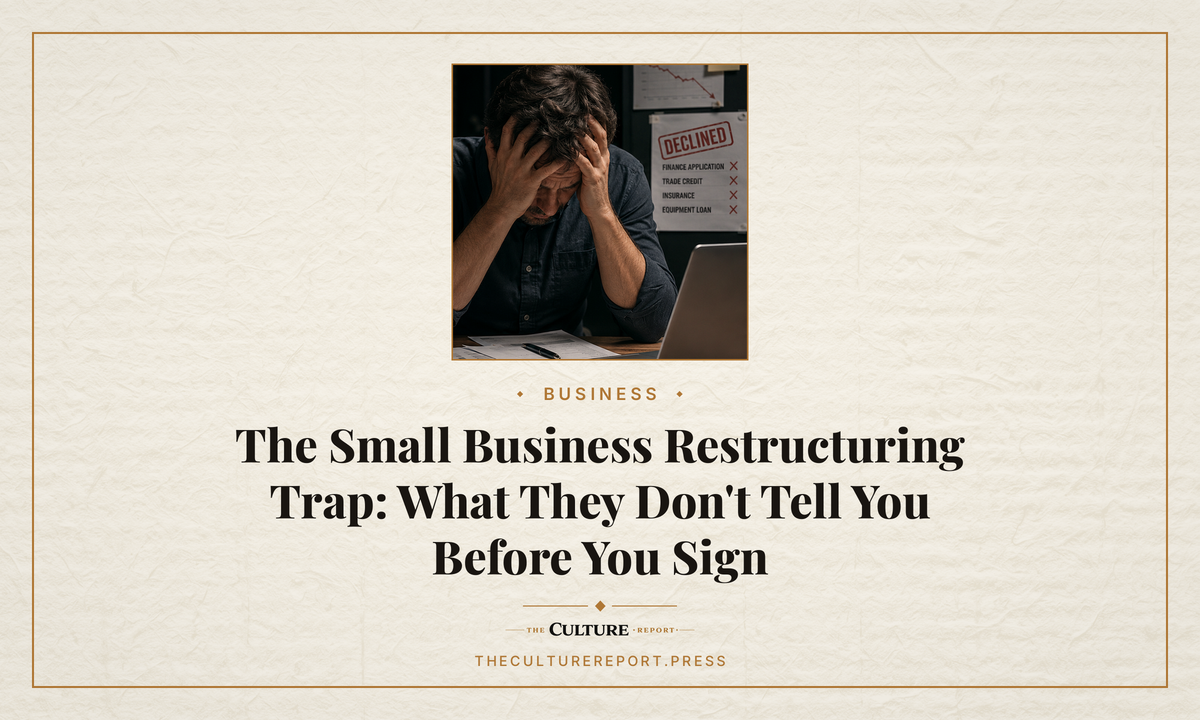
It may save your business from liquidation—but could it quietly destroy your ability to obtain credit?
By The Culture Report
When Australia's Small Business Restructuring (SBR) regime was introduced in January 2021, it was hailed as one of the biggest insolvency reforms in decades.
The promise was compelling.
Small businesses facing financial distress could restructure their debts while directors remained in control of the company. Rather than closing the doors, businesses could continue trading, preserve jobs and negotiate a compromise with creditors.
It sounded like a lifeline.
And for many businesses, it has been.
ASIC's own review found that the regime has helped many eligible businesses survive, with more than $101 million distributed to unsecured creditors through completed restructuring plans between 2022 and 2024.
But there is another side to the story.
One that many directors only discover after they have entered the process.
The Question Nobody Seems to Ask
Before entering an SBR, directors are usually focused on one thing.
Can we save the business?
It is the obvious question.
Perhaps the better question is this:
What will happen after we successfully complete the restructuring?
Because while an SBR may resolve today's debt problem, it can create tomorrow's funding problem.
The Public Record Most Directors Don't Appreciate
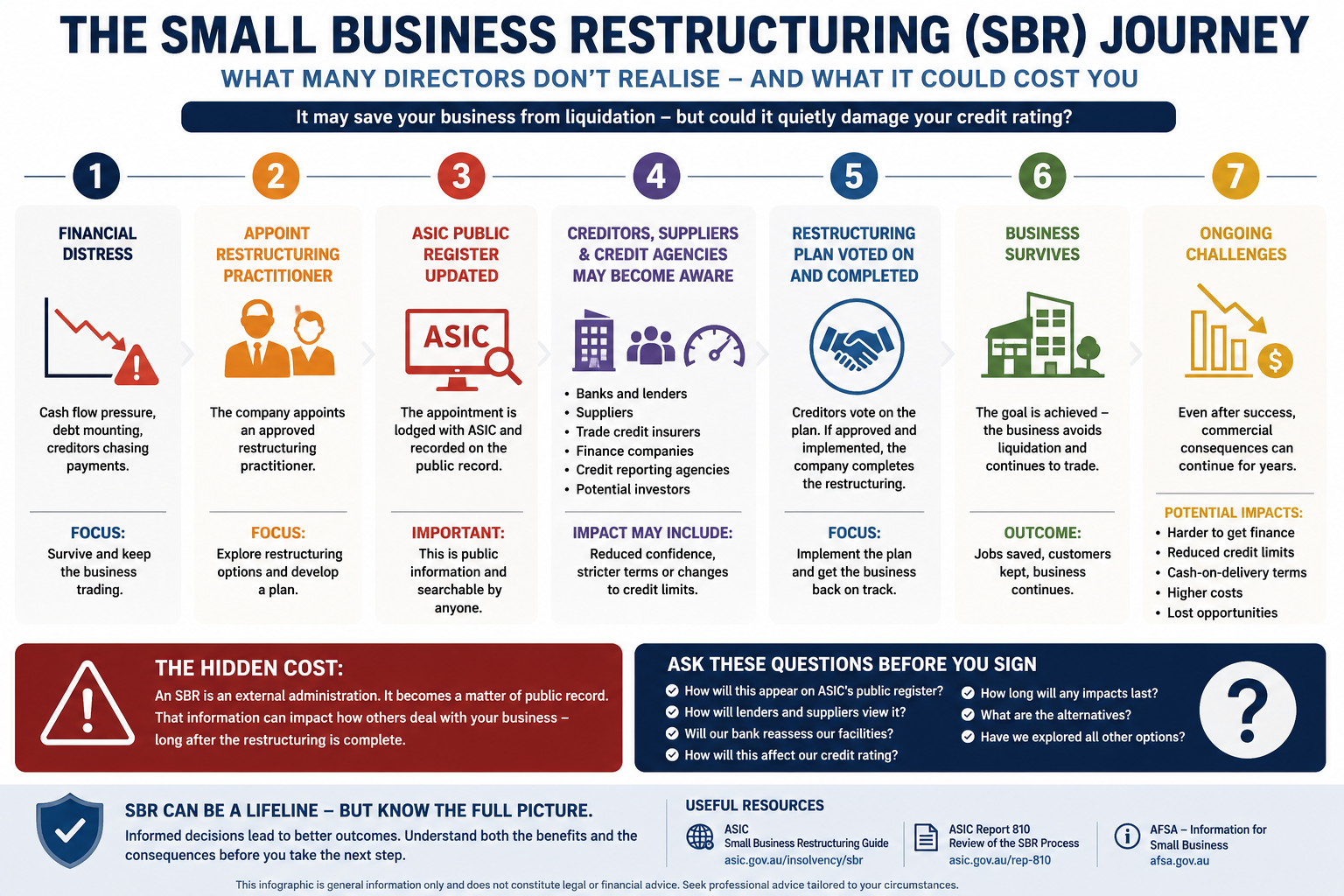
Many directors don't realise that appointing a restructuring practitioner is not a private arrangement.
It is an external administration under the Corporations Act 2001.
ASIC records the appointment on the public Company Register, making the company's restructuring status publicly searchable. During the restructuring period, company documents must also disclose that a restructuring practitioner has been appointed.
That information is available to:
- banks
- finance companies
- equipment lenders
- trade credit insurers
- suppliers
- commercial credit reporting agencies
- potential investors
ASIC itself notes that this public information "may impact creditors, suppliers, insurers or other parties' dealings with the company during restructuring."
That single sentence deserves far more attention than it receives.
Winning the Battle but Losing the War
Imagine this scenario.
A family business successfully negotiates an SBR.
Employees keep their jobs.
Creditors approve the plan.
The company survives.
The directors believe the worst is behind them.
Then they apply for equipment finance.
Declined.
A supplier reviews its commercial risk profile.
Trading terms change to cash before delivery.
The bank reassesses facilities.
An insurer reduces available trade credit.
Nothing illegal has occurred.
Nothing dishonest has occurred.
The company simply entered a lawful restructuring process.
Yet the commercial consequences may continue long after the restructuring has finished.
Is This Explained Clearly Enough?
That is the question policymakers should be asking.
No one disputes that directors receive legal advice about the restructuring process.
But are they equally informed about the practical commercial consequences?
Do they fully understand the potential impact on:
- commercial credit assessments
- supplier confidence
- banking relationships
- future borrowing
- equipment finance
- leasing arrangements
- trade insurance
For many directors, these issues determine whether the business can genuinely recover.
A Better Conversation
None of this is an argument against Small Business Restructuring.
In fact, the regime fills an important gap between informal workouts and liquidation.
Many businesses have undoubtedly survived because of it.
The issue is not whether SBR should exist.
The issue is whether directors receive sufficiently clear warnings about the long-term commercial implications before they commit.
Good public policy depends on informed decision-making.
Directors deserve to understand both the benefits and the costs.
Questions Every Director Should Ask
Before appointing a restructuring practitioner, consider asking:
- How will this appear on ASIC's public register?
- How might lenders view the restructuring?
- Will supplier credit terms change?
- Will equipment finance become more difficult?
- How will commercial credit reporting agencies record the restructuring?
- How long might any adverse commercial impacts remain?
- Have all alternatives been explored?
These questions should be answered before the appointment—not after.
The Bottom Line
The Small Business Restructuring regime has undoubtedly helped many Australian businesses avoid liquidation.
That should be recognised.
But survival is not measured solely by whether a company continues to exist.
A business also needs access to finance.
Supplier confidence.
Commercial credibility.
Working capital.
Without those things, restructuring can become merely a delay rather than a recovery.
Australia created the SBR regime to give small businesses a second chance.
The next step should be ensuring every director fully understands what that second chance may cost.
Useful Resources
ASIC – Small Business Restructuring Guide
https://www.asic.gov.au/regulatory-resources/insolvency/insolvency-for-directors/small-business-restructuring-and-the-restructuring-plan/
ASIC Report 810 – Review of the Small Business Restructuring Process (2022–2024)
https://www.asic.gov.au/regulatory-resources/find-a-document/reports/rep-810-review-of-small-business-restructuring-process-2022-24/
ASIC Media Release – SBRs Keeping Struggling Companies Afloat
https://www.asic.gov.au/about-asic/news-centre/find-a-media-release/2025-releases/25-111mr-asic-report-suggests-small-business-restructurings-are-keeping-struggling-companies-afloat/