The Great NDIS Reset: Why Thousands of Participants Are Losing Supports
Australia's disability scheme is entering its most significant reform yet. Here's what's already changed, what's still contested, and ten concrete steps participants and families can take to prepare.
Australia built the National Disability Insurance Scheme on a promise that need, not budget, would decide what a person received. That promise is now being renegotiated — quietly, unevenly, and largely through administrative machinery rather than public debate. For participants, the question is no longer whether the scheme will change, but whether they will be ready when it reaches them.
I. The reset nobody announced
There was no single moment at which Australia decided to shrink the National Disability Insurance Scheme. There was a growth target, then a review, then an Act, then a second Act, then a set of rules — and somewhere inside that sequence, the working definition of what the scheme owes a person with disability began to move.
The numbers explain the pressure. As at 31 March 2026 the scheme supported 774,456 active participants and paid out $50.17 billion over the preceding twelve months, at an average of $66,800 per participant. Costs grew 11.3 per cent over that year. National Cabinet's target, set in 2023, was 8 per cent by July 2026. The scheme did not reach it, and in April 2026 the Commonwealth stopped aiming for it: Minister Mark Butler announced a far tighter settlement — growth of about 2 per cent a year over four years, easing to 5 to 6 per cent in the medium term.
A target that moves from 8 per cent to 2 per cent is not an adjustment. It is a different scheme.
What makes this reset difficult to argue about is that it is arriving through process rather than proclamation. Eligibility is being redefined by assessment method. Plan values are being reshaped by funding periods. Whole categories of support are being relocated to systems that do not yet exist at scale. Each step is defensible on its own terms. The cumulative effect, for the person on the receiving end, is that the ground moves without anyone appearing to have moved it.
II. What has already happened
Much of the public argument about the NDIS is conducted in the future tense — projections, modelling, forecasts to 2030 and 2031. It is worth separating what is projected from what has already landed, because the distinction matters enormously to anyone deciding whether to act now.
Here is what has already landed. In May 2025 the Agency began applying shorter funding periods to plans under section 33 of the NDIS Act. By 30 September 2025, 105,694 participants had a three-month funding period applied. Of the 104,964 who were still active participants at that date, 21,056 — one in five — had a reduction in the annualised value of their plan. The average reduction was 22.5 per cent.
That figure was not a forecast. It was disclosed by the National Disability Insurance Agency in answer to a question on notice from Senator Jordon Steele-John, returned to the Senate Community Affairs Committee in November 2025. Twenty-one thousand people, on average losing something close to a quarter of their annual funding, before the major legislative reforms have properly begun.
It is also true that 49,974 participants in the same cohort saw their plan value increase. The reset is not a uniform contraction, and honest reporting should say so. But an average 22.5 per cent reduction, applied to tens of thousands of people, is the clearest available answer to the question of whether anyone is actually losing supports.
III. What is projected, and what is still contested
The larger numbers belong to a different category, and should be read differently.
In April 2026 the government projected that more than 160,000 people would leave the NDIS by around 2030 under a new eligibility model built on functional assessment rather than diagnosis. In June 2026, officials told a parliamentary inquiry that the figure across the full reform package was closer to 350,000 by 2031 — some 241,000 exiting the scheme, and around 110,000 prospective participants directed elsewhere instead of entering it. Average annual plan spend was projected to fall from roughly $31,000 to roughly $26,000.
These are the government's own estimates of the effect of a package that is not yet law. The National Disability Insurance Scheme Amendment (Securing the NDIS for Future Generations) Bill was introduced on 14 May 2026. It would allow the Minister to reduce funding across whole categories of support without individually reassessing each participant's plan, tighten the criteria for requesting an unscheduled reassessment, and replace diagnosis-based entry with standardised functional-capacity assessment. A snap parliamentary inquiry in June 2026 found the reforms, in its own description, on rocky ground.
So the honest position is this: tens of thousands of people have already had funding cut, and hundreds of thousands more sit inside a projection attached to legislation still being fought over. Neither fact cancels the other. Both are reasons to prepare.
IV. The machinery behind the change
The legal architecture matters, because it explains why the ground is moving in the particular direction it is.
The Getting the NDIS Back on Track No. 1 Act commenced on 3 October 2024. It did three things of consequence. It created a statutory definition of an NDIS support, with transitional lists of what is in and what is out — converting a question that had been argued case by case into one settled by instrument. It introduced impairment notices, which specify precisely which impairments qualify a person under the Act, narrowing the surface on which eligibility rests. And it laid the groundwork for a new planning model: a needs assessment producing a single total funding amount, replacing itemised, support-by-support budgeting.
That new planning model has been repeatedly deferred; the Agency is now working to 1 April 2027, with a first round of simulated assessments run on thirty participants in January 2026. The delay is often read as reprieve. It is better read as warning. When the model arrives, the document that determines a person's funding will be a standardised assessment of function — not a specialist's letter, not a history of what was funded last year.
Everything that follows in this article proceeds from that single fact.
V. Ten ways to prepare
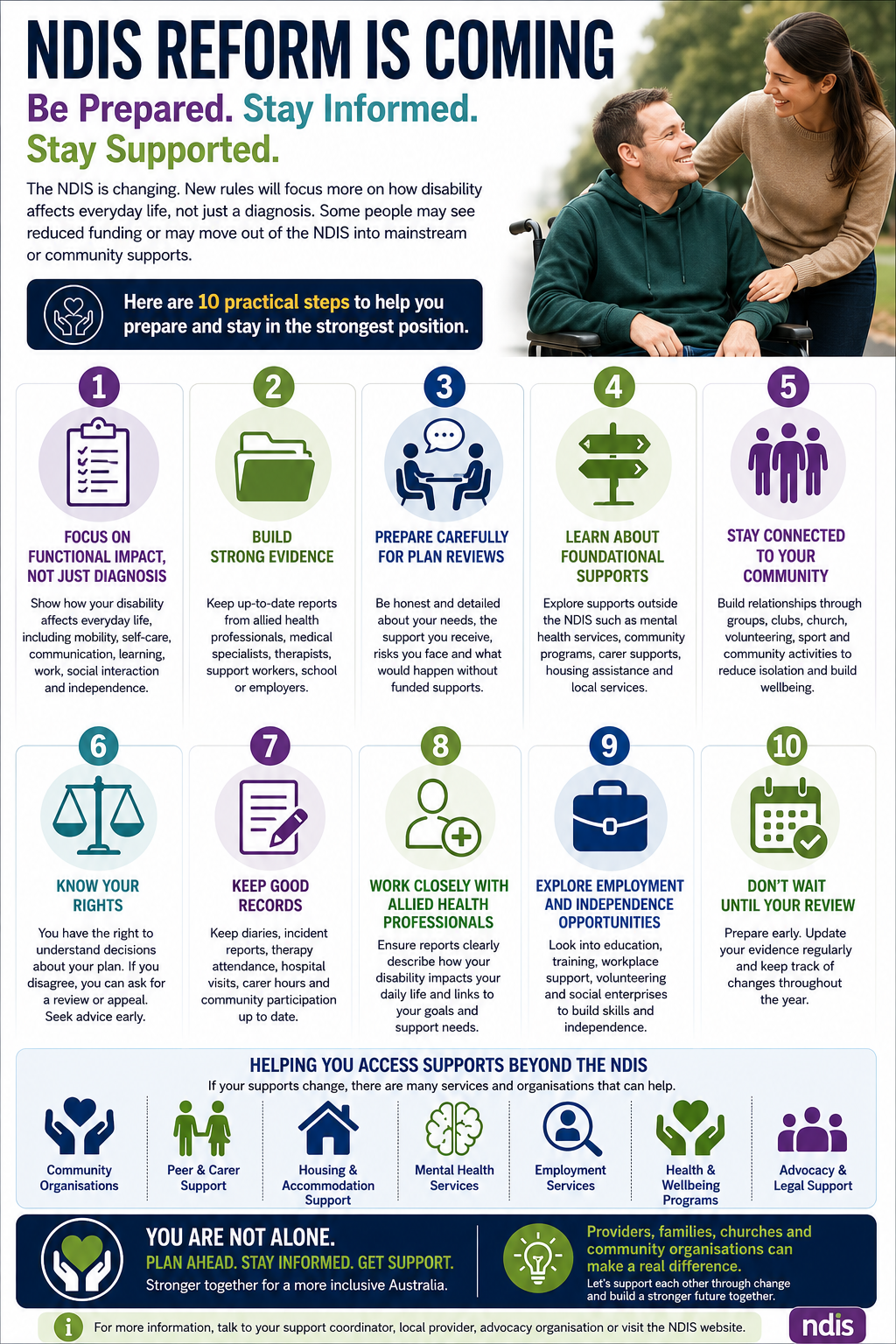
1. Function is the currency now, not diagnosis
The single most consequential shift in the scheme is that a diagnosis, on its own, decides less and less. What decision-makers increasingly assess is functional impact: how the disability affects a person's capacity to move through a day — to communicate, to learn, to work, to manage self-care, to participate in a community, to live independently.
This is not a bureaucratic quibble. Two people carrying identical diagnoses can have entirely different support needs, and the scheme has moved toward measuring the difference. The practical implication is that a report which establishes a condition but not its consequences is now a weak document. Participants should work with their treating professionals to ensure reports describe function in concrete, everyday terms.
2. Evidence is a file you maintain, not a document you find
Quality evidence has always mattered. Under a reassessment-driven system, it becomes the participant's principal asset — and it is far easier to maintain than to assemble under deadline.
A working evidence file should hold functional capacity assessments; occupational therapy, physiotherapy, psychology or psychiatric reports; speech pathology assessments; medical specialist reports; support worker observations; and school or employment assessments where relevant. The test is not volume but currency and specificity. A comprehensive, up-to-date file makes an ongoing support need demonstrable rather than assertable.
3. Describe the hard days, not the good ones
Plan reviews fail participants in a peculiar and consistent way: people understate their own difficulty. Asked how they are managing, most Australians say they are managing. In a review meeting, that instinct is expensive.
A review is not a conversation about resilience. It is an evidentiary account of need. It should set out what support is required each day; what risks arise without assistance; how much informal support family members are absorbing; what would happen if funded supports were withdrawn; and how fatigue, pain, behavioural challenges or fluctuating conditions change the picture across a week rather than a morning. Accuracy is not complaint. A planner can only work with the circumstances they are told about.
4. Learn the map outside the scheme
Foundational supports — services delivered outside the NDIS by state governments and community organisations — have moved from concept to agreement. The National Agreement on Foundational Supports 2026–31 commenced on 2 February 2026, capped at $10 billion over five years and split evenly between the Commonwealth and the states. Its first phase, Thriving Kids, covers children aged eight and under with developmental delay or autism and low-to-moderate support needs. State rollout is due to begin no later than 1 October 2026, delayed from July, with full scale by 1 January 2028 and the corresponding change to NDIS access arrangements from that date.
What sits in this category in practice: community participation programs, mental health services, carer supports, local council services, disability advocacy, housing assistance, peer support and community health programs. Knowing which of these actually exist in a particular postcode — not in principle, but in operation — is the difference between a managed transition and a gap.
5. Community connection is infrastructure
A significant share of NDIS funding buys social and community participation. It is precisely the category most exposed in the current reform debate; officials confirmed to the June 2026 inquiry that reductions of up to 50 per cent to social and community participation budgets had been under consideration.
Where funding retreats, relationships remain, and relationships are not a soft consolation. Church groups, sporting clubs, volunteer programs, men's and women's groups, community centres, disability social groups, arts and recreation programs — these are the structures that determine whether a reduction in funding becomes a reduction in life. They are also, unlike plan funding, entirely within a participant's power to build now.
6. Rights are not self-executing
Every participant has the right to understand a decision affecting their plan, and to challenge it. The review and appeal pathways remain open, and they are not ornamental.
The Agency's own reporting for 2024–25 records that 96 per cent of NDIS matters at the Administrative Review Tribunal were resolved before a substantive hearing — 73 per cent of those by agreement between the Agency and the participant. Of the matters that did reach a substantive decision, 55 per cent affirmed the original decision, 11 per cent varied it and 34 per cent set it aside. Read carefully, that is a system in which challenging a decision frequently changes it, and in which most change happens by negotiation rather than judgment.
The operative variable is timing. Advice sought early — from an advocacy organisation, a support coordinator, or a legal service — is worth considerably more than advice sought after a deadline has passed.
7. Keep the record that only you can keep
Documentation is the one form of evidence a participant controls entirely, and it captures what no single assessment can: how a disability behaves over time.
Useful records include daily support diaries, hospital admissions, falls and incidents, therapy attendance, changes in health, carer support hours, community participation, and equipment failures or safety concerns. A clinician sees a person for an hour. A diary sees them for a year, and a year is the unit in which need is actually assessed.
8. Ask allied health for the right document
Allied health professionals are the primary authors of the functional evidence the scheme now relies on — but only if they are asked for the right thing.
Reports should be current, specific, evidence-based, focused on everyday functioning, and explicitly linked to goals and support needs. A report that establishes a diagnosis answers a question the scheme has largely stopped asking. A report that explains what a person cannot do unassisted, and what happens when the assistance is absent, answers the question it now asks instead.
9. Independence, on the participant's own terms
The reform agenda actively encourages participation in education, employment and community life where appropriate. Participants who want to work may find real value in employment preparation, workplace modifications, skills development, social enterprises, volunteer pathways and career mentoring.
This point carries a caution the policy language rarely supplies. Independence pursued because a person wants it is a genuine gain. Independence assumed because a budget requires it is a cost transfer. Both are happening. Participants are entitled to pursue the first while naming the second.
10. Do not wait for the review
The most valuable advice in this article is also the least dramatic: prepare before you are asked to.
Evidence assembled in the fortnight before a reassessment is evidence assembled under pressure, and it shows. Evidence maintained across a year — updated reports, sustained contact with treating professionals, documented changes in circumstance — presents a picture that is both stronger and truer. Preparation lowers the stakes of any single meeting, which is the closest thing to security the current settlement offers.
VI. What providers and community organisations owe this moment
Reform of this scale is usually described as something that happens to participants. It also creates an obligation for everyone positioned around them.
NDIS providers, churches, charities and community organisations occupy a place the Agency does not: they are trusted, local, and present before a crisis rather than after it. That position can be used. Organisations can educate families about the review process before a review is scheduled. They can assist with evidence gathering. They can maintain a working knowledge of mainstream and foundational supports in their own area and connect people to them. They can provide advocacy and plain-language information. They can reduce isolation through programs that cost a fraction of the funded supports they partly substitute for. They can help participants understand both their rights and their responsibilities.
None of this requires a policy change or a new funding stream. It requires organisations to decide that navigating the reset is part of the service, and to say so out loud.
VII. Looking ahead
The NDIS remains one of the most ambitious social reforms Australia has attempted, and the case for sustainability is not in itself an attack on it. A scheme growing at 11.3 per cent a year against a target of 8 — now a target of 2 — was always going to be reshaped by something. Better that it be reshaped deliberately than by an eventual fiscal emergency.
But sustainability is a means, and it is being discussed as though it were the end. The scheme's purpose is to ensure that Australians living with permanent and significant disability receive the support they need to live a life of their own choosing. A reform that meets its growth target while failing that purpose has not succeeded; it has changed subject.
Three tests will show which is happening. Whether foundational supports arrive at genuine scale before NDIS access narrows, rather than after. Whether functional assessment is applied as a fairer instrument or a cheaper one. And whether the people affected are given the time, the information and the assistance to prepare — or are simply informed of outcomes already decided.
For participants and families, none of those tests can be waited on. The reset is already producing measurable reductions in real plans held by real people. Preparation is not pessimism. It is the one part of this process that remains, for now, entirely within their hands.
Where to get help
The NDIS Contact Centre can be reached on 1800 800 110. Free, independent advocacy is available through the National Disability Advocacy Program — the Disability Advocacy Finder at askizzy.org.au/disability-advocacy-finder lists providers by location. Participants who disagree with a decision can request an internal review within three months of being notified, and free legal assistance is available through community legal centres in every state and territory.